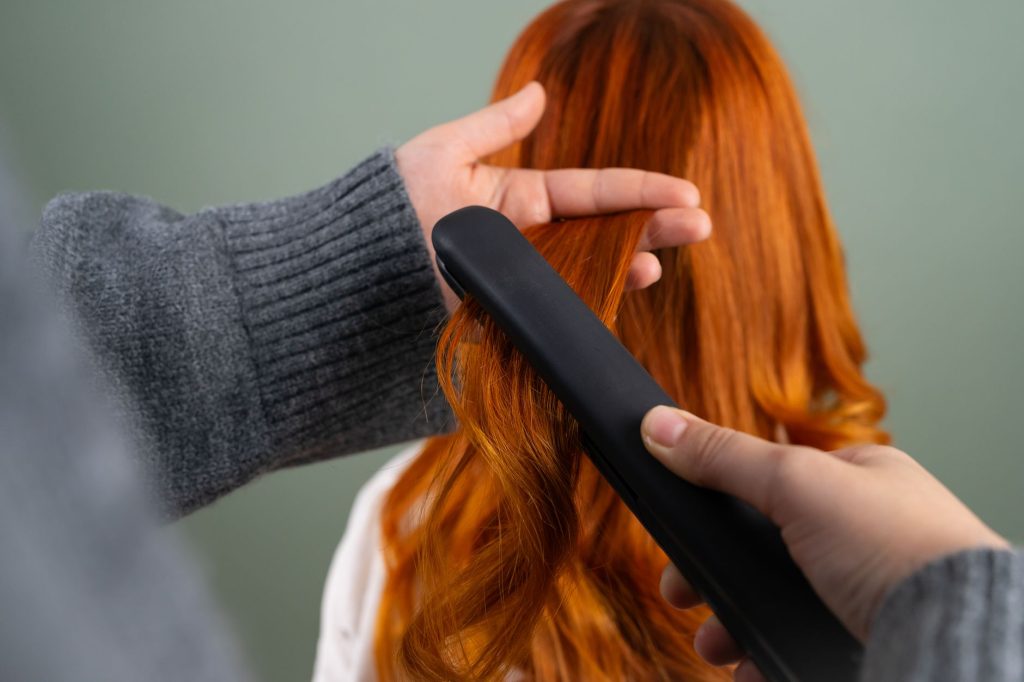
A straightener with a 230°C maximum is not telling you to use 230°C. It is telling you the range the plates can reach. The setting that suits your hair is usually well below the top of the dial, and using the maximum by default is the single most common way people damage hair with a tool that was working correctly.
- Device
- Flat iron or straightener
- Time
- 10 minutes
- Tools
- Heat protectant
- Difficulty
- No disassembly
What heat does to hair
Hair is a protein structure with water bound inside it. Heat straightening works by softening the bonds that hold the hair’s shape long enough to reshape it, then letting it cool in the new position. Applied gently, this is reversible. Applied hard, it drives out the bound water faster than it can be replaced and permanently alters the protein — which is what people describe as heat damage.
The distinction between those two outcomes is not sharp, and it moves with hair type, condition and how wet the hair is when the plates arrive.
Choosing a starting point
- Start lower than you think Begin at the lowest setting that has any effect and work up in steps. The setting you need is the one that straightens a section in a single slow pass. If you are going over the same section three times, the temperature is not high enough and you are applying three doses of heat instead of one.
- Fine, light or damaged hair needs less Fine hair has less mass to absorb heat, so the same setting reaches a higher internal temperature. Bleached and chemically treated hair is already structurally compromised. Both call for the low end of the range.
- Coarse, thick or very curly hair needs more More mass and a tighter structure need more energy to reshape. This is where higher settings are legitimate, and where too low a setting causes damage by forcing repeated passes.
- Never straighten wet or damp hair Water inside the shaft turns to steam against hot plates. Hair must be fully dry unless the tool is specifically designed to be used on damp hair, in which case that will be stated prominently rather than buried.
- Use a heat protectant It does not make heat harmless. It slows heat transfer and reduces moisture loss, which shifts the outcome from damaging towards survivable at the same setting.
Why the number on the dial may not be the number at the plate
Straighteners vary in how accurately they hold temperature. Cheaper tools often overshoot on heat-up and swing widely during use, so a dial reading of 180°C can mean anything from 160 to 210 in practice. Better tools hold closer to their setpoint and recover faster after each pass.
You cannot measure this at home, but you can infer it. A tool that scorches at a setting you have used comfortably on another tool is running hotter than it claims, and the sensible response is to drop the setting rather than assume your hair changed.
Fewer passes beats a lower setting
There is a trade-off people get backwards. Total damage depends on both the temperature and the number of times heat is applied. A single slow pass at a moderate setting delivers less cumulative stress than four fast passes at a low one, because each pass restarts the cycle of heating and drying.
Work in sections thin enough for the plates to reach through in one pass. Sections that are too thick are the usual reason people end up going over the same hair repeatedly and then blame the tool.
Frequency matters more than any setting
The American Academy of Dermatology recommends letting hair air dry when possible, using the lowest effective heat setting, and limiting how often heat tools touch hair — aiming for around once a week or less. That last point is the one with the largest effect. A perfect technique used daily will do more cumulative damage than an imperfect one used occasionally.
If straightening is part of your routine several times a week, the highest-value change is not the dial. It is finding one or two days where the hair goes untouched.
Signs you are running too hot
A faint smell of burning, visible steam or crackling from dry hair, ends that feel rough immediately after styling, and hair that will not hold the style are all signs of too much heat rather than too little. So is a straightening result that looks good on day one and noticeably worse after the next wash, which is what happens when the shaft has lost water it cannot replace.
Sources
- 10 hair care habits that can damage your hair — American Academy of Dermatology
- Tips for healthy hair — American Academy of Dermatology