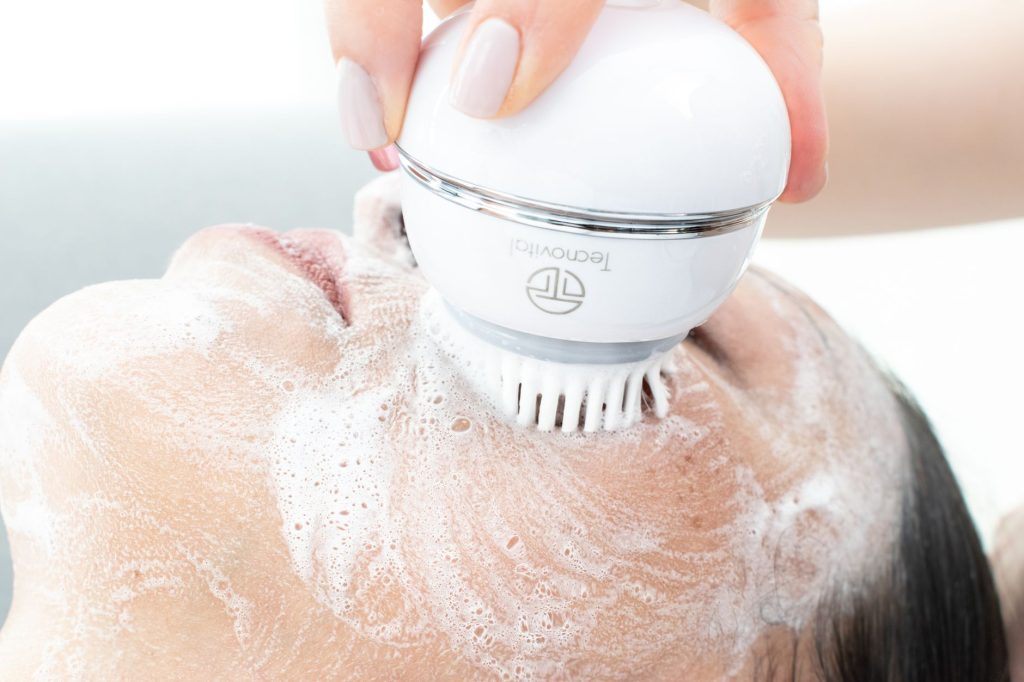
A cleansing brush that has stopped charging is one of the more recoverable faults in a bathroom. These devices are sealed, wet, and charged through contacts or a coil — three conditions that produce charging failures which look terminal and usually are not.
- Device
- Sonic or rotating cleansing brush
- Time
- 30 minutes plus charging
- Tools
- Dry cloth, cotton bud
- Difficulty
- No disassembly
How these devices charge
There are two common arrangements. Some brushes have metal contacts on the base that meet matching contacts on a cradle. Others charge inductively: a coil in the base couples with a coil in the charger through a sealed plastic shell, with no exposed metal at all.
Knowing which you have matters, because the failure modes are different. Contact charging fails from corrosion and residue. Inductive charging fails from alignment and from anything that increases the gap between the two coils.
Work through it in this order
- Look at the contacts, if there are any Metal contacts in a bathroom acquire a film of limescale, soap residue and oxidation. It is often invisible until you look closely under good light. Clean both the device and the cradle with a dry cloth or a cotton bud lightly dampened with isopropyl alcohol, then let both dry completely before reconnecting.
- Dry the base thoroughly Many brushes refuse to charge when moisture bridges the contacts, and some deliberately inhibit charging when they detect it. A device that has been sitting in a wet cradle may simply need both parts left to dry overnight.
- Check the alignment on an inductive charger Inductive coupling falls off quickly with distance and offset. A brush resting slightly off-centre, or on a cradle sitting on an uneven surface, may charge slowly or not at all. Seat it deliberately and look for whatever indicator the device uses.
- Try a different power source Test the charger in a different socket, and if it uses a USB supply, try a different adapter. Low-output adapters are a frequent cause: a charger that works on a 10W supply may do nothing on a low-power port.
- Leave it far longer than seems reasonable A deeply discharged lithium cell may show no indicator at all for the first stage of charging while the circuit brings it back to a safe voltage. Give it several uninterrupted hours before concluding nothing is happening.
- Check whether it is a travel or transport lock Some models ship with a lock that disables the motor and can be mistaken for a flat battery. Check the manual for your model rather than assuming the indicator means what you think.
Telling a charging fault from a dead battery
They present differently. A charging fault usually means no indicator response at all when the device is placed on the cradle, or an indicator that responds intermittently when the device is moved. A worn battery charges normally — the indicator behaves as it always has — but the run time has collapsed, often over months rather than suddenly.
Rechargeable cells lose capacity with age and cycles, and a device three or four years into daily use running for a fraction of its original time is behaving as expected rather than failing.
Habits that shorten charging life
Storing the brush permanently on a powered cradle in a hot, damp bathroom is the fastest route to both corroded contacts and a tired cell. Charge it, take it off, and store it dry. Rinse and dry the base after use rather than leaving standing water where the contacts are.
Water hardness matters more than people expect. In hard-water areas, limescale builds on contacts within months, and it is the most common reason a brush that charged fine in one home charges poorly in another.
When the brush is not the problem
If the device charges and runs but cleansing has started to irritate your skin, the charging system is a distraction. The American Academy of Dermatology advises gentle cleansing without scrubbing, and a worn or overly stiff brush head works against that regardless of how well the battery holds.
Persistent redness, stinging or new breakouts are a reason to stop using the device and let skin settle, and to see a dermatologist if they continue. No amount of troubleshooting the charger addresses that.
Sources
- Face washing 101 — American Academy of Dermatology