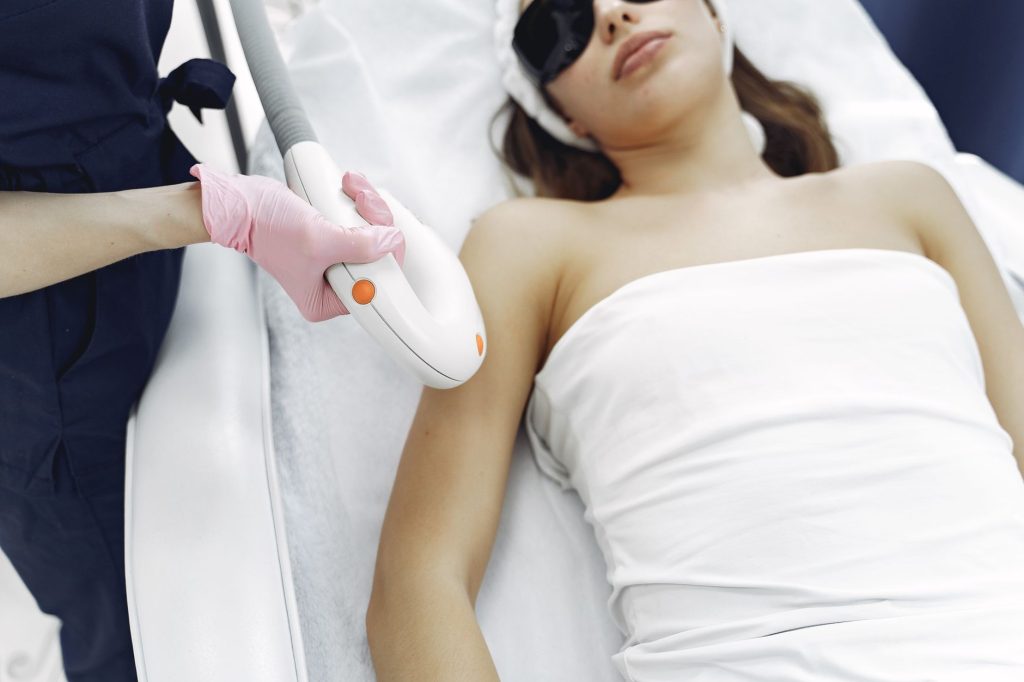
An IPL handset that powers on, charges, and then refuses to flash is usually working exactly as designed. Most of these devices will not fire unless several conditions are true at once, and when one of them is not met the handset stays silent rather than telling you which one it was.
This guide covers the interlocks that stop a home IPL device from firing, in the order worth checking, and how to tell a refusal from a fault.
- Device
- IPL hair removal handset
- Time
- 10 minutes
- Tools
- None
- Difficulty
- No disassembly
What IPL is, and why it refuses
IPL is not a laser. A laser emits one wavelength; an intense pulsed light device emits a broad band of wavelengths through a filter. In hair removal, that light is absorbed by melanin — the pigment in the hair — and converted to heat at the follicle.
The problem is that melanin in skin absorbs the same light. The darker the skin, the more energy lands where it is not wanted, and the higher the risk of a burn or a lasting change in skin colour. The American Academy of Dermatology is direct about the consequences of light-based hair removal going wrong: burns, permanent changes in skin colour, and scarring.
That single fact explains most of the refusals below. A home device is sold without a clinician in the room, so the manufacturer builds the caution into the hardware.
The checks, in order
- The skin tone sensor has locked the device out Nearly every home IPL handset has a sensor in the treatment window that reads how much light your skin reflects. If it reads darker than the threshold the manufacturer set, the device will not fire — on that patch of skin, at that moment. This is the most common reason for a silent handset, and it is not a fault. A tan you have picked up since the last session is enough to change the reading. So is moving from a forearm to a bikini line.
- The device is not flat against skin A second sensor confirms the treatment window is fully in contact with skin before the flash is allowed. Partial contact — over a bony area, at the edge of a treated patch, on a curved surface like an ankle or an upper lip — leaves part of the window open, and the interlock holds. Press flat and square rather than harder.
- The area is not prepared the way the manual assumes Manufacturer instructions for these devices generally assume skin that is shaved, clean, dry, and free of residue. Lotion, deodorant, sunscreen, makeup and self-tanner all sit between the window and the skin, and self-tanner in particular changes what the tone sensor reads. Unshaved hair absorbs the energy above the skin, where it does nothing except heat the surface.
- It is still charging or too hot Many handsets will not fire while connected to a charger, and most stop firing when the lamp assembly gets too warm, resuming after a cool-down. A device that fired ten times and then stopped is usually in thermal cut-out rather than broken. Check the manual for your model — the behaviour varies, and some corded devices deliberately fire only on mains power.
- The lamp has reached its flash limit IPL lamps are consumable. Manufacturers rate them for a fixed number of flashes, and devices with replaceable cartridges stop firing when the count runs out. Devices with a sealed lamp reach end of life the same way, they just cannot be refilled. If your handset counted down to zero, the silence is the end of the lamp, not a fault.
- The safety key or lock is engaged Some models ship with a lock, a child-safety mode, or a separate eye-protection interlock that must be cleared before the trigger does anything. It is worth ruling out before assuming hardware failure.
Telling a refusal from a fault
A refusal is silent, repeatable and tied to a condition: it happens on one area and not another, or with the charger connected and not without it. A fault does not follow a pattern — the device fails to power on at all, the indicator behaves in a way the manual does not describe, or the handset fires inconsistently on the same patch of skin under the same conditions.
Indicator codes are worth reading before anything else. Manufacturers publish them in the manual and in support articles, and they distinguish between the two cases better than any general guide can. A pattern that means “skin tone too dark for this device” and a pattern that means “service required” often look similar to someone who has not looked them up.
Skin tone eligibility is not a setting
The skin tone limit on a home IPL device is a boundary of what the device is cleared for, not a preference you can adjust. Devices are marketed against the Fitzpatrick scale, and most home handsets exclude the darkest skin types entirely because the risk of burns and pigment change cannot be managed without a clinician present.
If your device consistently refuses to fire anywhere on your body, the most likely reading of that is that the device is not intended for your skin, and no amount of troubleshooting changes it. Light-based hair removal for darker skin exists, but it uses different equipment in a clinical setting.
When to stop and contact the manufacturer
Home IPL handsets are sealed devices containing a capacitor bank charged to a level that is dangerous to handle. There is no user-serviceable part inside, opening the case will void any warranty, and there is no repair that a guide can walk you through.
Contact the manufacturer if the device does not power on, if the indicator shows a code the manual lists as service-related, if it fires when not in contact with skin, or if it has caused any skin reaction beyond what the manual describes as expected.
Sources
- Laser hair removal: overview — American Academy of Dermatology
- Dermatologists debunk common misconceptions about laser hair removal — American Academy of Dermatology
- 6 ways to remove unwanted hair — American Academy of Dermatology
- Medical lasers — U.S. Food and Drug Administration
- 510(k) summary K221679, IPL hair remover — U.S. Food and Drug Administration