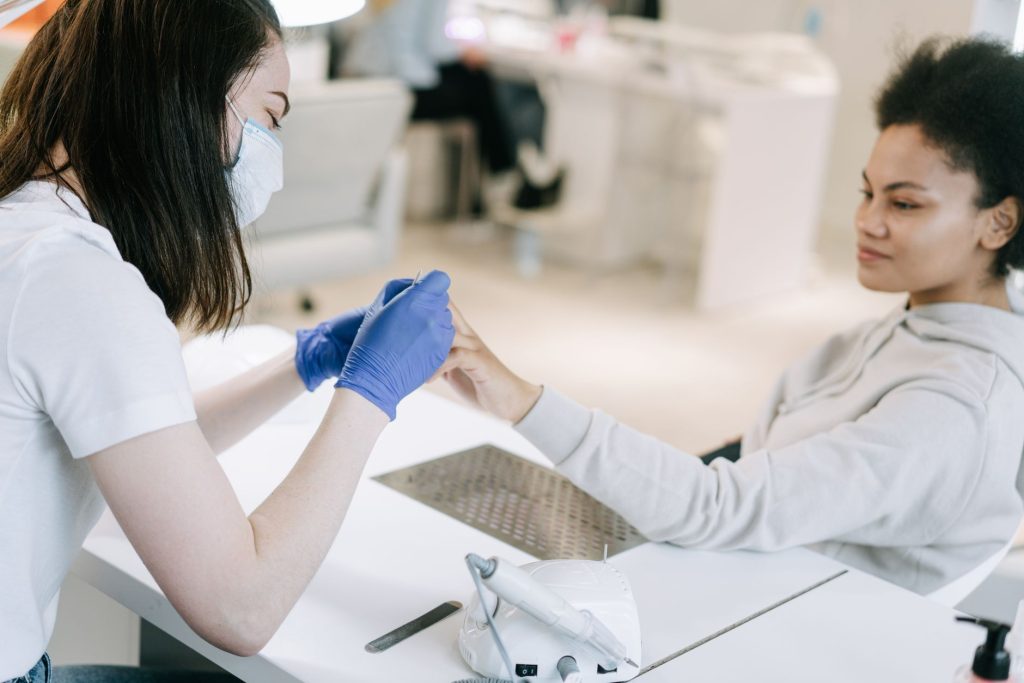
Filing gel or acrylic produces a fine dust that stays airborne for a long time. In a salon this is managed with extraction. At home it is usually managed by not thinking about it.
- Device
- Electric nail file
- Time
- 15 minutes to set up
- Tools
- Extraction or a fitted mask
- Difficulty
- No disassembly
What the dust is
The visible powder on the table is the coarse fraction, and it is not the part that matters. Filing also produces particles small enough to remain suspended in air for extended periods and small enough to be inhaled deeply. Those particles are cured product — polymer, pigment, and whatever else was in the formulation — along with fragments of natural nail.
The distinction matters because the coarse dust settles and can be wiped up, while the fine fraction stays in the room after the visible mess is gone.
Why a paper mask is only part of an answer
- Fit dominates filtration A mask that gaps at the sides lets air take the easy path around the filter. A loose surgical-style mask offers far less protection than its filter rating suggests.
- Filtration class matters Masks rated for fine particulates are a different product from a basic barrier mask, and the rating is usually printed on the mask itself.
- Masks protect the wearer only If you are filing someone else’s nails, your mask does nothing for them. That is what extraction is for.
- Extraction beats filtration Capturing dust at the source removes it before it disperses. A downdraft or dust collector positioned close to the hand is more effective than any mask, and the two together are better than either.
A workable home setup
Work near an open window with air moving away from you rather than across your face. Use a dust collector if you file often enough to justify it — the units sold for home use are modest but they capture at the source, which is the point. Wear a fitted mask rated for fine particulates rather than a loose one.
Wipe surfaces with a damp cloth rather than brushing them, which re-suspends everything you just settled. And do not eat or drink at the station; fine dust settles into anything left open.
Skin and eyes
Uncured product is a different hazard from cured dust. Liquid monomers and uncured gels can sensitise skin, and once someone is sensitised the reaction tends to persist. Avoid skin contact with uncured product, do not touch the skin around the nail with it, and cure fully rather than leaving thin uncured margins.
Eye protection is worth wearing when filing. Fragments leave the bit at speed, and a fragment of cured acrylic in an eye is a straightforward injury.
Why this is worth the trouble at home
Salons manage this because they do it all day, and the exposure of a professional is not comparable to someone doing their own nails twice a month. But the setup that protects a professional costs very little to approximate, and the practices — extraction at source, a mask that fits, damp cleaning, no food at the station — take no extra time once they are habits.
The American Academy of Dermatology’s guidance on manicure safety is worth reading alongside this, particularly on cuticles and on giving nails periods without enhancements.
Sources
- 11 dermatologists’ tips for healthy nails — American Academy of Dermatology
- Manicures and pedicures — American Academy of Dermatology
- Ultraviolet (UV) radiation — U.S. Food and Drug Administration